Brentwood, New York · Nationwide Stocking Distribution [email protected] · 1-800-SATCO-US
Retrofit Guide

A Retrofit Conversation That Stays Grounded in What Is Actually Installed

Most retrofit projects stall because ceiling conditions, fixture family continuity, and emergency backup coverage were not talked through early. This page is Satco's way of keeping those three threads visible before the purchase order leaves the desk.
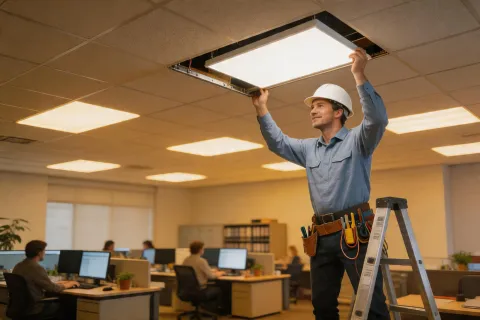
Satco retrofit guide visual

The Three Retrofit Questions We Ask First

Question 01

What Does the Ceiling Actually Look Like?

Acoustic T-bar grid, drywall housing, surface mount, or legacy fluorescent troffer each point toward a different retrofit route. We start with the ceiling, not the SKU.

Question 02

Does the Fixture Family Need to Stay Consistent?

Portfolio upgrades feel calmer when A19, BR30, PAR30, troffer, and vanity families carry a recognizable line across buildings instead of drifting with each reorder.

Question 03

Where Does Emergency Backup Fit In?

UL 924 emergency drivers, combo exit and emergency units, and self-diagnostic modules need to live next to the retrofit lamps, not in a separate procurement silo.

Lamp vs Kit vs Full-Fixture Swap

RouteWhen It Usually FitsFriction to Watch
Lamp-Only SwapExisting ballast is within service life and compatible with Type A LED.Ballast end-of-life creeps up and causes nuisance failures.
Driver-Bypass LampBallast is aging, but housing and trim are still in good shape.Field wiring change requires qualified electrician, not building engineer.
Retrofit KitHousing is solid, optics are tired, full swap is out of scope or budget.Fit check on ceiling grid depth and J-box orientation.
Full-Fixture ReplacementTrim, optics, and housing all dated or mismatched across buildings.Ceiling rework scope and tenant-occupied schedule.

Selection Trade-Offs Worth Naming Out Loud

Retrofit specifiers disagree on these three questions more often than catalogs admit. Here is how the counter desk frames the trade-off before the SKU list is locked.

Trade-Off 01

Efficacy vs Visual Comfort

Prioritize efficacy: Higher lm/W lowers operating cost and helps meet utility rebate or sustainability targets on a portfolio retrofit. Prioritize comfort: Lower glare, tighter optics, and better UGR improve occupant satisfaction even when fixture efficacy drops a few lm/W. We usually lean comfort in tenant-occupied offices and efficacy in warehouse high-bay.

Trade-Off 02

Wired vs Wireless Controls

Choose wired: Deterministic 0-10V or DALI performance, easier enterprise integration, no battery-maintenance questions down the line. Choose wireless: Less conduit work, faster phased rollout, lower retrofit disruption on tenant floors. We pick wired when controls are part of a BMS handoff, wireless when the ceiling is already closed.

Trade-Off 03

Integrated Fixtures vs Modular Stack

Integrated package: Single-vendor warranty, simpler procurement, one cut sheet per space. Modular stack: Separate fixture, driver, and control layers give swapability and tuning flexibility for future upgrades. Integrated tends to win on speed, modular on long-horizon portfolio serviceability.

Retrofit Checklist Before the Purchase Order

Mixing 3500K and 4000K lamps in the same ceiling makes buildings feel off even when every SKU is technically compliant. We flag CCT drift before the SKU list is locked.

0-10V, line-voltage, and phase-cut dimming each behave differently. We confirm the dimming family on file before the order ships.

UL 924 coverage needs to follow the egress plan, not the lamp plan. We align emergency driver count to the path-of-egress drawing before the retrofit set is finalized.

Utility rebates usually need the DLC listing number and a matched cut sheet. We bundle both with the PO acknowledgement so applications are not chased later.

Multi-floor programs get allocation conversations up front. We stage release dates to match the tenant-occupied schedule instead of dumping the full order on day one.

Bring the Walkthrough Notes and We Will Frame the Retrofit

Building type, fixture count, ceiling conditions, and the emergency coverage you already have on file are usually enough to start.